


Table of Contents[Hide][Show]
- What VLT means and where the NSW rules come from
- NSW tint limits by window (VLT table)
- Windscreen tint and sun strips in NSW
- Fines and defect notices for illegal tint
- Privacy glass, rear windows and commercial vehicles
- Reflectance, film condition and UV: the other NSW rules
- Tint laws in other states
- Conclusion
What Is the Darkest Legal Tint in NSW?
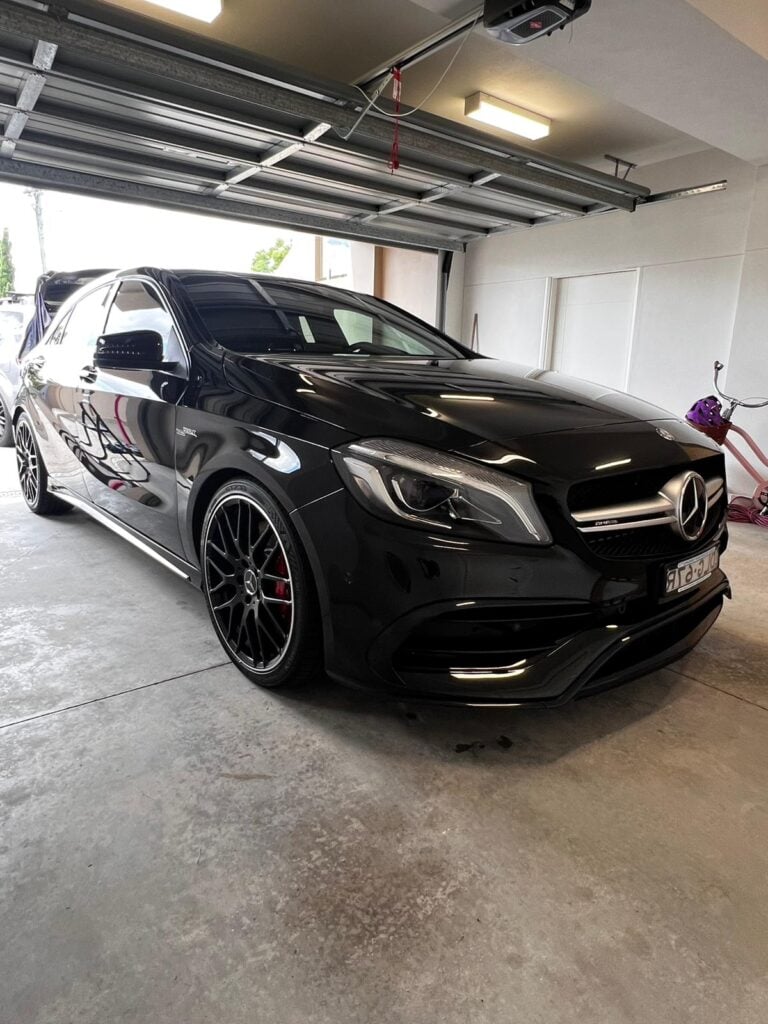
The darkest legal tint in NSW is 35% VLT on the front side windows. Rear side windows and the rear window can go to 20% VLT, but only if the car has a rear-vision mirror on each side. The windscreen can only carry a strip across the top, and the limits measure glass and film together.
Key takeaways
- Front side windows: 35% VLT minimum.
- Rear side windows and rear window: 20% VLT, but only if the car has a rear-vision mirror on each side; otherwise 35%.
- Windscreen: no film on the glass, only a band across the top.
- The limit measures glass and film together, so factory privacy glass counts toward it.
What VLT means and where the NSW rules come from
VLT stands for visible light transmission. It is the percentage of light that passes through the glass and film together. A lower number means a darker window, so 20% is darker than 35%.
NSW sets a minimum VLT for each window on a passenger car. The rules come from Rule 44 of Schedule 2 to the Road Transport (Vehicle Registration) Regulation 2017. Transport for NSW publishes a plain-English fact sheet on the same rules, and the table below follows it.
This page covers NSW passenger cars and light goods vehicles. Every state writes its own rules for aftermarket film, so a tint that passes in Sydney may fail in Brisbane. If you drive in another state, see our guide to the darkest legal tint in Australia.
NSW tint limits by window (VLT table)
| Window | Minimum VLT in NSW | Condition |
|---|---|---|
| Windscreen | 70% glass, no film | A tinted band is allowed across the top only (see below) |
| Front side windows (driver and front passenger) | 35% | Applies to every passenger car |
| Rear side windows | 20% | Only if the car has a rear-vision mirror on each side. Otherwise 35% |
| Rear window | 20% | Only if the car has a rear-vision mirror on each side. Otherwise 35% |
| Goods vehicles (utes, vans) behind the driver | No minimum | Needs a mirror on each side, built mainly to carry goods, and at least 4 wheels (or 3 wheels and a GVM over 1 tonne) |
| Any tinted window | Reflectance no more than 10% | Mirror-finish film is out, low-reflectance film is fine |
Three details catch people out:
- The limit is for the finished window. Factory glass and film are measured together, so a 35% film on glass that already blocks some light can land below 35%.
- The 20% rear allowance depends on mirrors. Almost every modern car has a mirror on each door, but a car with a driver-side mirror only is held to 35% all round.
- Damaged film counts. Transport for NSW lists damaged tint that impairs the driver’s visibility as not allowed, so bubbling, cracked or purple film needs replacing.
The pink slip inspection checks all of this. The NSW light vehicle safety check standard requires the examiner to test the light transmittance of the windscreen, side and rear windows.
The meter may read up to 5 percentage points low. So an examiner will not reject a car until the reading drops below 30% on a 35% window, or 15% on a 20% window. That is an inspection tolerance, not a lower legal limit.
Want film fitted to the limit without the guesswork? Schmicko’s mobile window tinting in Sydney comes to your home or work and installs carbon or ceramic film within NSW limits.
Windscreen tint and sun strips in NSW
You cannot tint the main area of a front windscreen in NSW. Windscreen glass must keep at least 70% VLT and must not be coated in any way that reduces it.
The exception is a band across the top. The band can cover no more than 10% of the windscreen height, or the area above the wiper sweep, whichever is greater. So on a windscreen where the wipers stop well below the top edge, the strip can be taller than 10%.
The rest of the glass must stay clear. A full windscreen film of any shade, including a light 70% ceramic film, is not permitted on a NSW registered car.
Fines and defect notices for illegal tint
Illegal tint is a vehicle standards offence, not just a cosmetic issue. The regulation says a person must not use a light vehicle on a road unless it complies with the Light Vehicle Standards Rules. The maximum court penalty for that offence is 20 penalty units, and a NSW penalty unit is $110, so up to $2,200.
On-the-spot penalty notice amounts are set separately and change over time. Check the current figure with Revenue NSW before relying on it.
A police officer or Transport for NSW can also issue a vehicle defect notice. The notice is marked major or minor. It states the date after which the car must not be used on the road and sets a repair deadline.
A major defect notice comes with a defective vehicle label stuck to the car. Only Transport for NSW can authorise its removal.
To clear a notice, you remove the film, then provide approved evidence that the car is no longer defective. The notice can be cleared by Transport for NSW, an authorised examiner or an authorised person. Until then, the car stays off the road from the date on the notice.
Privacy glass, rear windows and commercial vehicles
Factory privacy glass is tinted glass, not film. Many SUVs, wagons and people movers leave the showroom with dark rear glass already near the 20% mark. Transport for NSW is clear on this point. Its fact sheet says: “The combined VLT of the privacy glass PLUS the applied film must be within the regulated VLT limits.”
That rules out adding a dark film over privacy glass. A light or clear film may still be possible if the finished window measures at or above 20%. That is why a good installer meters the glass before quoting.
Commercial vehicles follow a different rule behind the driver. A vehicle built mainly to carry goods, with a mirror on each side and at least four wheels, has no rear VLT minimum.
The windscreen and the front side windows on those vehicles keep the same 70% and 35% limits as a car. Trucks and heavy buses fall under separate heavy vehicle standards.
Reflectance, film condition and UV: the other NSW rules
Reflectance is limited to 10%. The rule does not ban reflective film outright, it bans film that throws back more than a tenth of the light. Standard carbon and ceramic films sit well under that.
Film must stay in good condition. Bubbling, cracking and fading all reduce what the driver can see, and Transport for NSW treats damaged tint that impairs visibility as a fail.
UV protection is often oversold. The Victorian vehicle standards note says tint film may not significantly reduce UV transmission, because vehicle glass already blocks most UV. Specific UV-protective films are available, so treat heat rejection and glare as the main reason to choose one film over another.
Finally, who sets these rules. Australian Design Rule 8 covers safety glazing on every new vehicle nationally, including the 70% windscreen requirement. The rules for film added after manufacture sit with each state, which is why NSW, Victoria and Queensland differ.
Tint laws in other states
Victoria, Queensland, South Australia, Western Australia and the territories each publish their own limits. Some differ on the windscreen band, some on the rear window. Our darkest legal tint in Australia guide covers them state by state, so this page stays focused on NSW.
FAQs
Is 5%, 10%, 15% or 20% tint legal in NSW?
On a passenger car, 20% is the darkest legal tint behind the driver, and only with a mirror on each side. Anything darker than 20% there, including 5%, 10% and 15%, is not legal on a car. The front side windows must stay at 35% or lighter.
A goods vehicle such as a ute or van can go darker than 20% behind the driver.
Is 20% or 35% tint darker?
20% is darker. VLT is the share of light that gets through, so 20% lets through less light than 35%. The darkest legal combination on a NSW car is 35% on the front side windows and 20% behind the driver.
Is 30% tint legal in NSW?
Not on the front side windows, where the finished window must measure 35% or above. A 30% film is legal on the rear side windows and rear window if the car has a mirror on each side. Those windows can go down to 20%.
Can you tint the front windscreen in NSW?
Only as a strip across the top. The strip can cover the greater of 10% of the windscreen height or the area above the wiper sweep. The rest of the windscreen must keep at least 70% VLT and cannot carry any film.
Can I put film over factory privacy glass?
Only if the glass plus the film still measures 20% or above on windows behind the driver. Most factory privacy glass is already close to that figure, so a dark film will usually push it over the limit. Ask the installer to meter the glass first.
Does a pink slip check window tint?
Yes. The NSW light vehicle safety check standard requires the examiner to test the light transmittance of the windscreen, side and rear windows. A reading up to 5 percentage points under the minimum is accepted because of meter inaccuracy. So a 35% window fails below 30% and a 20% window below 15%.
Does window tint block UV?
Vehicle glass already blocks most UV, so the Victorian vehicle standards note says tint film may not significantly reduce UV inside the car. Specific UV-protective films exist if that is your priority. Choose film on heat rejection and legal VLT first.
Conclusion
The darkest legal tint in NSW is 35% VLT on the front side windows and 20% on the rear windows of a car with a mirror on each side. The windscreen takes a top strip only, film reflectance stays under 10%, and glass and film are measured together. Get those four points right and the car passes its pink slip without drama.
Ready to tint within the limit? Book mobile window tinting with Schmicko in Sydney, with carbon film from $300 and ceramic film from $500, fitted at your home or workplace. If you are budgeting first, see what car window tinting costs in Sydney.

Hi, I’m Chester
author, Automotive Service writer
As a seasoned author on our team, Chester also known as ‘Gadget’, for his love for all things mechanical, brings a wealth of experience and expertise to the table, particularly when it comes to automotive topics.